

Reviewed by the Doors In Motion Service Team — Licensed & Insured Garage Door Specialists Serving Illinois Since 1969.
If you’ve ever stepped into your garage in the middle of a January cold snap or a humid July afternoon, you already know how much the outside temperature affects that space. Whether your garage stays comfortable or swings wildly with the weather often comes down to one decision: insulated vs non-insulated garage doors.
It’s not just a comfort question, either. The door you choose affects noise levels, durability, condensation, and how hard your garage door opener has to work over time. Here’s how the team at Doors In Motion breaks down the real differences, so you can decide which option actually fits your home.
What Does “Insulated” Actually Mean for a Garage Door?
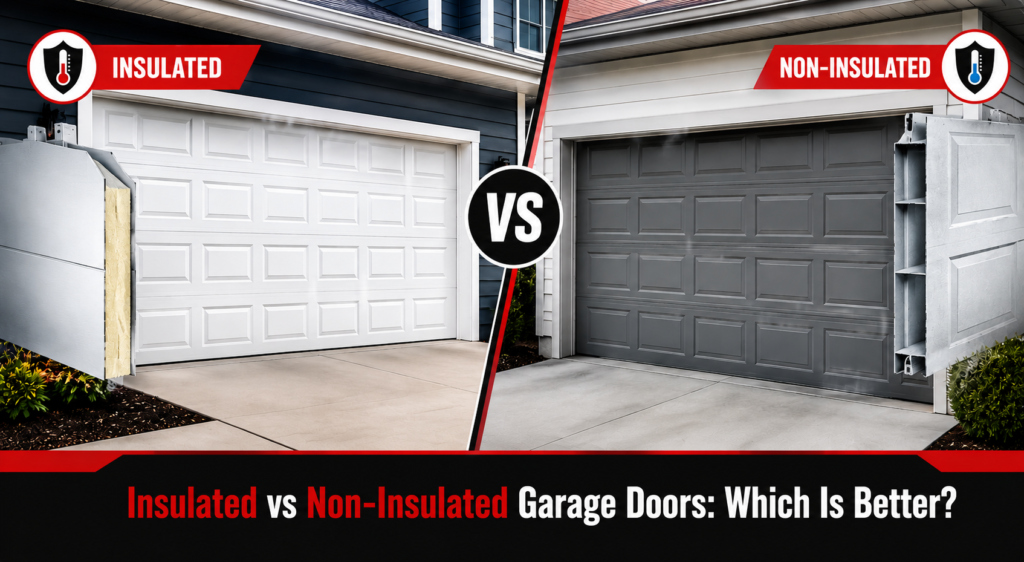
An insulated garage door isn’t just a thicker version of a standard door. It’s built with a layer of insulating material sandwiched between steel or other exterior panels, designed to slow the transfer of heat and cold through the door.
Single-Layer vs Double-Layer vs Triple-Layer Construction
- Single-layer doors are a single sheet of steel or other material with no insulation core. These are the classic non-insulated garage door.
- Double-layer doors add a layer of insulation, usually polystyrene, behind the exterior steel skin.
- Triple-layer doors sandwich insulation between an exterior and interior steel skin, offering the most complete thermal barrier along with added rigidity and dent resistance.
Understanding R-Value and U-Factor
Garage door insulation performance is typically described using two measurements. According to the Door and Access Systems Manufacturers Association (DASMA), R-value measures how well an individual material resists heat flow, while U-factor reflects heat transfer across the entire door assembly, including seams and hardware. In simple terms: a higher R-value means better insulation, and a lower U-factor means less heat escaping or entering through the door as a whole.
How Non-Insulated Garage Doors Perform
Non-insulated doors are typically a single layer of steel, aluminum, or wood with no thermal barrier.
Where they hold up well:
- Lighter weight, which puts less strain on the opener and springs
- Simpler construction with fewer failure points
- A practical option for detached, unheated garages used mainly for storage
Where they fall short:
- Little resistance to outside temperature swings, so the garage tends to match whatever it’s like outdoors
- More prone to condensation on the interior panel during humid or freezing conditions
- Thinner steel panels tend to transmit more outside noise and vibrate more when closing
How Insulated Garage Doors Perform
Insulated doors use one of two common materials to fill the space between panels.
Polystyrene Insulation
Polystyrene is a rigid foam board insulation, generally offering a lower R-value than polyurethane. It’s a solid option for moderate insulation needs and is commonly used in double-layer door construction.
Polyurethane Insulation
Polyurethane is sprayed in as a liquid foam that expands to fill the entire cavity, bonding directly to the interior and exterior steel skins. This creates a stronger, more rigid door with a notably higher R-value per inch than polystyrene, along with better resistance to denting and warping.
Where insulated doors excel:
- More stable interior garage temperature, regardless of what’s happening outside
- Reduced noise from opening, closing, and daily operation
- Less condensation buildup, since the interior surface stays closer to room temperature
- Added structural rigidity, especially with polyurethane core construction
Insulated vs Non-Insulated: Key Differences at a Glance
| Feature | Non-Insulated | Insulated |
|---|---|---|
| Temperature Regulation | Minimal | Strong (especially with polyurethane) |
| Noise Reduction | Lower | Higher |
| Condensation Resistance | Lower | Higher |
| Dent & Impact Resistance | Moderate | Higher (with polyurethane core) |
| Weight | Lighter | Heavier (opener may need adjustment) |
| Best Suited For | Detached, unheated garages | Attached garages, workshops, heated spaces |
Which Is Better for a Cold, Humid Climate Like Illinois?
Climate plays a big role in this decision. Illinois sees the full range of weather extremes — freezing winters, humid summers, and everything in between — which puts non-insulated doors at a disadvantage. A homeowner in Naperville dealing with a January cold snap faces the same insulation question as someone in Aurora managing a sticky, humid July.
An insulated garage door helps buffer the garage from the temperature swings we’ve covered in our posts on preparing for freezing temperatures and how humidity affects garage door performance. That buffering matters even more if your garage is attached to the house, since an uninsulated door lets outside temperatures transfer more directly into an adjoining room — something we hear about often from homeowners around Schaumburg and Elgin, where attached garages are common in newer developments.
Do You Need an Insulated Door If Your Garage Is Detached?
Not necessarily. If your garage is fully detached, unheated, and used mainly for storage or parking, a non-insulated door can be a perfectly reasonable choice. The main tradeoffs to keep in mind are less temperature stability, more potential for condensation, and slightly more operational noise — none of which matter much if the space isn’t climate-controlled or frequently occupied.
That said, if you ever plan to use the garage as a workshop, home gym, or additional living space, insulation is worth factoring in from the start rather than retrofitting later.
Common Misconceptions About Garage Door Insulation
- “Insulation only matters in extreme cold.” In reality, insulated doors also help in hot, humid weather by reducing heat transfer and limiting condensation.
- “All insulated doors perform the same.” R-value varies significantly between polystyrene and polyurethane doors, and even between different thicknesses of the same material.
- “Insulation is only about temperature.” Insulated doors also tend to be quieter and more resistant to dents, thanks to the added rigidity from the foam core.
- “A non-insulated door is a bad choice.” For detached, unheated garages, it’s often a practical and perfectly suitable option.
How to Decide Which Option Is Right for Your Home
Ask yourself these questions before choosing:
- Is your garage attached to your home, or detached?
- Do you heat or cool the garage space at any point in the year?
- Do you use the garage as a workshop, gym, or living space?
- Is noise from the door a concern for anyone inside the house?
- Does your garage tend to develop condensation or a musty smell?
If you answered yes to two or more of these, an insulated door is likely the better long-term fit for your home.
When to Talk to a Professional
Choosing between an insulated and non-insulated garage door affects more than comfort — it also plays into the weight the opener and springs need to handle, so it’s worth getting professional input before deciding. Doors In Motion provides garage door installation, garage door service and repair, and garage door maintenance for homeowners throughout Illinois, and can help you weigh insulation options based on your garage’s setup and how you use the space.
Frequently Asked Questions
Do insulated garage doors really make a noticeable difference?
Yes. Insulated doors help stabilize garage temperature, reduce condensation, and cut down on outside noise, especially when built with a polyurethane foam core.
What’s the difference between polystyrene and polyurethane garage door insulation?
Polyurethane is a sprayed, expanding foam that bonds directly to the door’s steel skins, offering a higher R-value per inch and more structural rigidity than polystyrene, which is a rigid foam board insert.
Is a non-insulated garage door a bad choice?
Not necessarily. For a detached, unheated garage used mainly for storage, a non-insulated door is often a practical option with fewer components to maintain.
Does an insulated garage door affect the opener or springs?
Yes. Insulated doors are heavier than non-insulated doors, so the opener and springs need to be properly matched to the door’s weight during installation.
Can I add insulation to an existing garage door?
In some cases, yes — insulation kits are available for retrofitting certain non-insulated doors, though a full insulated door typically offers more consistent, factory-tested performance.
Contact Us for Garage Door Services and Repairs
At Doors in Motion Inc, we specialize in helping homeowners choose the perfect garage door based on their climate, lifestyle, and aesthetic preferences. Whether you’re in need of garage door repair or installation services, our team is here to guide you.
Call us today at (847) 222-0400 or contact us online for a free consultation.
Explore More Resources
By selecting the right materials and keeping your garage door in top condition with our garage door repair and maintenance services, you’ll enjoy long-lasting protection, improved energy efficiency, and better curb appeal.
Final Thoughts
Choosing between insulated vs non-insulated garage doors comes down to how your garage is used and how much temperature stability, noise reduction, and durability matter to you. Insulated doors offer clear advantages for attached garages, workshops, and homes in a climate with real seasonal extremes, while non-insulated doors remain a practical fit for detached, unheated spaces.
If you’re weighing your options, Doors In Motion helps homeowners throughout the Chicagoland area choose the right garage door construction for their climate and how they actually use their garage. A professional consultation can make the decision a lot easier.
Summary
Insulated garage doors offer better temperature regulation, noise reduction, and condensation resistance than non-insulated doors, making them ideal for attached garages, workshops, and cold or humid climates. Non-insulated doors remain a practical, lightweight option for detached, unheated garages used mainly for storage.